






Houshang Seyhoun: Contemporary Architect and Painter
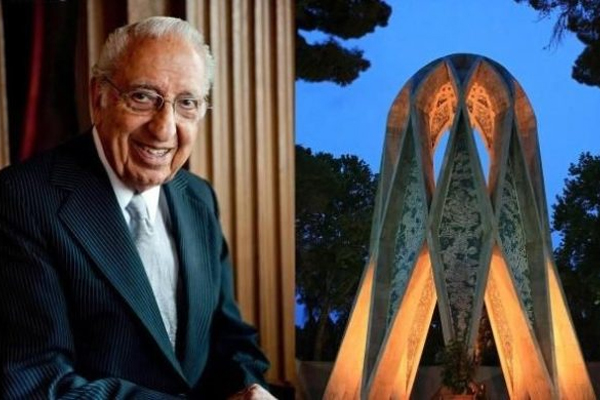
Houshang Seyhoun: Contemporary Architect and Painter
Houshang Seyhoun is one of the most important figures in Iranian architecture and contemporary art, showcasing an artistic fusion of modern design logic and rich traditional roots. His enduring works, ranging from historical mausoleums to charcoal drawings, demonstrate how one can respect the past while simultaneously employing the language of today.
Life and Artistic Family
Houshang Seyhoun was born on August 22, 1920 (31 Mordad 1299) in Tehran. The family in which he grew up was filled with music and art:
- Maternal Grandfather: Mirza Abdollah Farahani, the father of Iranian traditional music
- Mother: Moloud Khanom, Tar and Setar player
- Uncle: Ahmad Ebadi, a prominent master of the Setar
- Father: Ziyallah Seyhoun, a student of Mirza Abdollah
Despite this background, his family never forced him to learn music. Later, Seyhoun’s “Kalef-line” (scribble) designs became a tribute to this artistic heritage.
Education and Start of Professional Career
Studies in Tehran and Paris
After receiving a degree in architecture from the Faculty of Fine Arts, University of Tehran (1944), Seyhoun traveled to Paris at the invitation of Andre Godard and studied at the École nationale supérieure des beaux-arts (École des Beaux-Arts) under Otello Zavaroni. In 1949, he successfully received a Doctorate of Arts.
First Major Project
At the age of 23, he took on the design of the Avicenna Mausoleum; a building that revealed his innovative vision from the very beginning.
Academic and Cultural Activities
Upon returning to Iran, Seyhoun taught at the Faculty of Fine Arts for many years and served as the dean of the faculty between 1962 and 1968. His most important actions during this period were:
- Establishing three disciplines: Urban Planning, Performing Arts, and Music
- Encouraging students to go on research trips and gain close familiarity with Iranian culture and architecture
He was also a member of the National Archaeological Council, the High Council of Urban Planning, the Central Council of Iranian Universities, and the International ICOMOS Committee (affiliated with UNESCO), and he held the responsibility for restoring historical buildings in Iran for over 15 years.
Architectural Style and Philosophy

Houshang Seyhoun believed:
“No line or point in architecture should be illogical.”
Key Features of His Style
- Simplicity and Proportion: True beauty comes from the harmony of volumes and forms, not from excessive decorations.
- Modern and Native Materials: The first Iranian architect to openly use iron and cement while simultaneously utilizing Iranian stone and brick.
- Inspiration from Tradition: The combination of stone and wood in the Shemshak House and the pure brick language in the Farah Educational Complex are prominent examples of this approach.
View on Islamic Architecture
Seyhoun considered the term “Islamic Architecture” incorrect and sought the roots of many of this architecture’s techniques in the Sassanid era.
Prominent Works and Major Restorations

Some of his most significant works and restoration projects include:
- Avicenna Mausoleum – Hamadan
- Khayyam Mausoleum – Nishapur
- Restoration of Ferdowsi Mausoleum – Tus
- Nader Shah Mausoleum – Mashhad
- Kamal-ol-Molk Mausoleum – Nishapur
- Bank Sepah Building – Tehran
- Museum of Tus and Yazd Cultural Center
The restoration of the Ferdowsi Mausoleum was one of his most important achievements, creating a sturdy and impressive structure by preserving the initial design and adding new sections.
Painting and Artistic Works

Alongside architecture, Seyhoun also seriously pursued painting. His known works include:
- The charcoal collection “A Look at Iran”
- Oil paintings “The Crow’s Wing” (Kalagh Par) and “Concert”
The book “Half a Century of Seyhoun’s Architectural and Painting Works” has recorded a significant part of his visual portfolio.
Honors and Awards
- First rank in the Avicenna Mausoleum design competition
- First rank in the Iran Railway Station building competition
- Dean of the Faculty of Fine Arts, University of Tehran
- Honorary Citizen of France
- Recipient of the Beta Award in 2012
Personal Life and Later Years
In the 1950s (1330s SH), Seyhoun married Masoumeh Noshin, a painter and owner of Seyhoun Gallery, and they had two children named Maryam and Nader. This marriage ended in separation after 23 years. He lived in Vancouver, Canada, for over two decades and finally passed away in that city on May 26, 2014 (5 Khordad 1393) at the age of 93.
Conclusion
Houshang Seyhoun built a bridge between traditional Iranian architecture and the modern global language through his enduring works. He showed that design logic, simplicity, and respect for native materials can create a timeless legacy that continues to inspire future generations.