






Pen Cutting for Determining Angle and Delicacy of Writing in Calligraphy
Pen Cutting for Determining Angle and Delicacy of Writing in Calligraphy
This article has been prepared by Sohreh-e Honar Iran website and made available to you, dear users. Our main topic is examining one of the most fundamental yet delicate skills in calligraphy: Pen Cutting for Determining Angle and Delicacy of Writing. Pen cutting plays a fundamental role not only in the quality of the letters but also in the fluidity of the pen’s movement and creating harmony in the writing structure. Calligraphers have long recognized this delicate art as a bridge between their tool and their artistic thought. In this article, we have attempted to provide a clear and practical perspective for you enthusiasts by examining the history, features, applications, and challenges of pen cutting.
History and Roots
The art of pen cutting has a history of several hundred years in Islamic and Iranian civilization. Ancient calligraphers invented various methods for cutting pens to achieve the precise angle of the pen and create smooth, uniform lines. In different schools of calligraphy, such as Nasta’liq, Thuluth, and Naskh, different methods for cutting pens and choosing specific angles were common. This tradition has remained as one of the most important preliminaries of calligraphy from the passage of time until today and is considered a kind of precious heritage.
Features and Nature of the Technique/Material
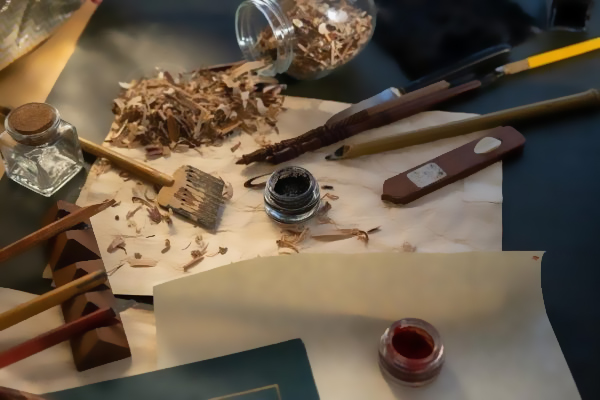
Pen cutting is not merely cutting a reed or pen for writing, but it is an artistic and technical process performed with precision and delicacy. The angle of the pen, the width of the nib, the sharpness or dullness of the cut, and its flexibility are all factors that influence the final result of the writing. Choosing the right pen angle can make the difference between simple writing and an artistic work. Also, the quality and type of reed or wood used in the pen are very important, and with proper cutting, maximum efficiency can be extracted from it.
Application in Contemporary Art
In contemporary calligraphy, pen cutting is still taught as one of the basic principles of calligraphy education. Many masters emphasize that students must cut their own pens to establish a deeper bond with their work tool. Alongside this, modern artists have also created fresh visual effects by changing pen cutting techniques. The use of special pens with different angles has made it possible to create textures and diverse styles in modern calligraphy works.

Benefits and Challenges
Despite its numerous benefits, pen cutting also has its specific challenges. Among the benefits, we can mention the artist’s complete control over writing quality, increased delicacy and precision of lines, and creating harmony in writing. However, this technique requires experience, high precision, and extensive practice. One of the challenges is the breaking of the pen nib during cutting or writing, which can disrupt the work. Also, beginner students usually face difficulties in achieving the correct angle.
Summary Information Table
Practical Tips for Artists
- Always use a sharp and special knife for cutting the pen.
- Choose the pen angle according to the type of script (Nasta’liq, Naskh, Thuluth, etc.).
- After each cut, polish the pen nib on a stone or glazed paper to make its movement smoother.
- Continuous practice in pen cutting not only increases the quality of your writing but also deepens your understanding of the structure of the script.
Conclusion
As one of the important foundations of calligraphy, pen cutting plays a unique role in determining the quality, angle, and delicacy of writing. This skill, which has been common among Iranian and Islamic calligraphers for centuries, has still maintained its place in education and the creation of artistic works today. With a correct understanding of this technique and continuous practice, every artist can achieve greater beauty and fluidity in their works. As we saw in this article, Pen Cutting for Determining Angle and Delicacy of Writing is not only a technical skill but a bridge between tradition and contemporary art, and its value in the world of calligraphy will always remain lasting.